
Business segment review
Cement
We are one of the leading grey cement manufacturers in South India, operating two integrated plants in Telangana and Andhra Pradesh. The region continues to witness a growing demand and we are focused on maximising our capacity utilisation and contributing to India’s rising infrastructure development.
Sales volume
Revenue from
operations
Contribution to
consolidated
revenue

| Product portfolio | |||
|---|---|---|---|
 Ordinary Portland Cement (OPC)
|
 Portland Pozzolana Cement (PPC)
|
||
| Raw materials |
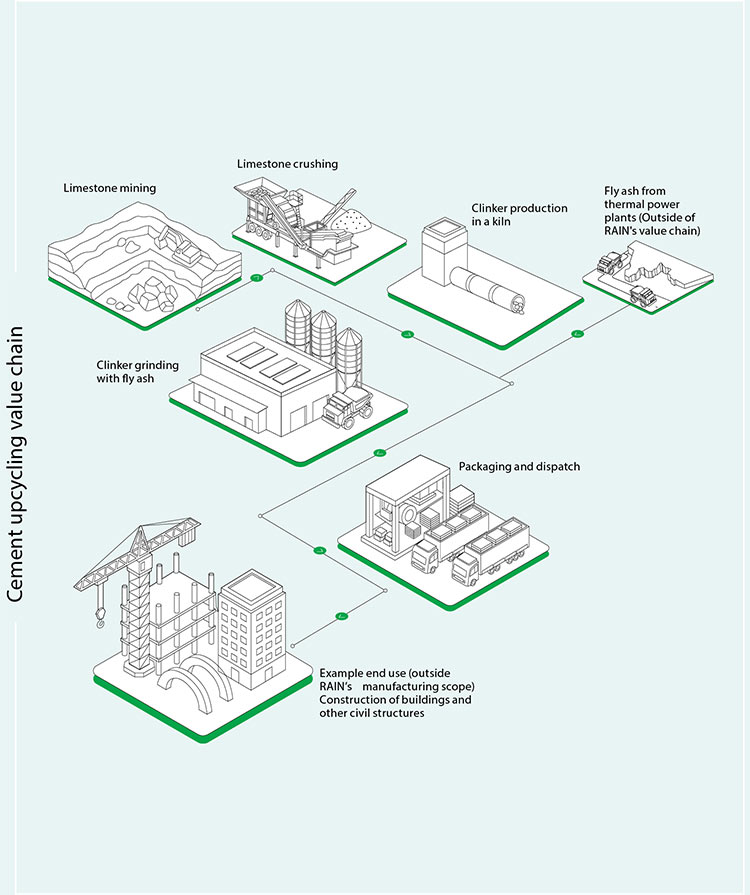
Limestone and gypsum | Limestone, gypsum and fly ash, a byproduct of thermal power plants | |
| End-industry applications |
Structural concrete used in high-rise buildings, commercial complexes and infrastructure projects | Reinforced cement concrete for residential construction, plastering and brickwork | |
| Production locations |
India | India | |
We operate two strategically located production facilities that adhere to stringent BIS standards and produce highquality Ordinary Portland Cement (OPC) and Portland Pozzolana Cement (PPC) under the Priya Cement brand. With infrastructure spending on the rise, we are strengthening our ability to meet growing regional demand through adequate production capacity and reliable logistics support. During the year, we optimised logistics efficiency by reducing sales to distant markets such as Kochi and Pune and increasing our focus on markets closer to our plants, supporting cost optimisation across operations.
Capacity utilisation against
65-70% industry average nationally
During the reporting year, the segment navigated persistent market pressures, stemming primarily from consolidation among national players and regional weather conditions. The period commenced with declines in both revenue and EBITDA, reflecting lower volumes and a drop in selling prices. In response, we shifted our focus to stabilisation, resulting in improved realisations across most operating regions, although overall volumes remained flat. Additionally, we undertook operational efforts to optimise outward freight costs. However, the environment deteriorated during the monsoon season, causing volume reductions specifically in Andhra Pradesh and Telangana. This seasonal downturn, coupled with a marginal fall in sales realisation and higher coal consumption per tonne, impacted our margins.
India's cement demand remained resilient, with national production increasing from 438.1 million tonnes in 2024 to 475.6 million tonnes in 2025, reflecting growth of approximately 8.5%, while installed capacity stood at 441.9 million tonnes and is projected to reach 602.7 million tonnes by 2030 (CAGR ~6.4%). Demand continues to be supported by sustained public infrastructure spending, including the ₹11.21 lakh crore Union Budget allocation for transport infrastructure, the ₹15.39 lakh crore PM-GatiShakti project pipeline and the ₹10 lakh crore PMAY-Urban 2.0 housing programme. However, regional overcapacity in the South and East has intensified pricing pressure, while extended monsoons and higher imported pet coke costs (up over 20%), combined with a 6% rupee depreciation, weighed on margins.
We are prioritising operational efficiency and cost optimisation to navigate moderate capacity utilisation and pricing pressures, while maintaining disciplined supply deployment across key markets. The strategic expansion of captive solar electricity generation capacity at our cement plants is further lowering production costs and enhancing long-term cost competitiveness. At the same time, we remain positioned to benefit from improving demand conditions through pricing discipline, network optimisation, and calibrated capacity scaling aligned with the industry upcycle.
During 2025, we received necessary permissions to initiate a brownfield expansion at our Cement segment's site in Suryapet, India at a strategic time in the near future. The project will increase clinker capacity from 1.0 to 2.5 million tonnes and expand waste-heat recovery electricity capacity from 5 MW to 12 MW. Alongside this, we progressed captive renewable power initiatives and continued logistics optimisation through greater market alignment. Our total cement capacity remained at 4.0 million tonnes across operations in Telangana and Andhra Pradesh.
Developing our net zero roadmapIn 2025, we initiated the development of a net zero roadmap for our Cement segment in collaboration with the Confederation of Indian Industry (CII). This exercise focuses on assessing our environmental footprint, and identifying opportunities to enhance efficiency across carbon emissions, water use and waste management. The current phase is centred on establishing baselines and strengthening data systems.
Decarbonisation roadmapWe are establishing a baseline for carbon emissions, assessing future emission trajectories, and identifying technological levers and potential measures to support emissions reduction.
We are assessing baseline water extraction, consumption and recycling, while reviewing water metering systems, and identifying opportunities to improve water use efficiency and rainwater harvesting.
Net zero waste roadmapWe are establishing baseline data for waste generation and disposal, strengthening data systems, and identifying opportunities to reduce waste and improve recycling practices.
Strategic focus areas for 2026
In 2026, our focus will remain on improving cost competitiveness through freight optimisation, strengthened quality assurance processes, upgraded laboratories and additional solar electricity generation, supporting the future and a new production line. We are also enhancing market engagement and channel development to support stable demand participation while maintaining disciplined execution of ongoing expansion initiatives.