
Business segment review
Carbon
The Carbon segment converts byproducts from oil refining and steel production into high-value, carbon-based products, which are then used to manufacture aluminium, graphite electrodes, carbon black and titanium dioxide.
Sales volume
Revenue from
operations
Contribution to
consolidated
revenue
Industries we serve
- Aluminium
- Graphite electrode
- Carbon black
- Wood preservation
- Titanium dioxide
- Refractory and others
| Product portfolio | |||
|---|---|---|---|
| CPC | CTP | Other carbon products | |
| Raw materials |
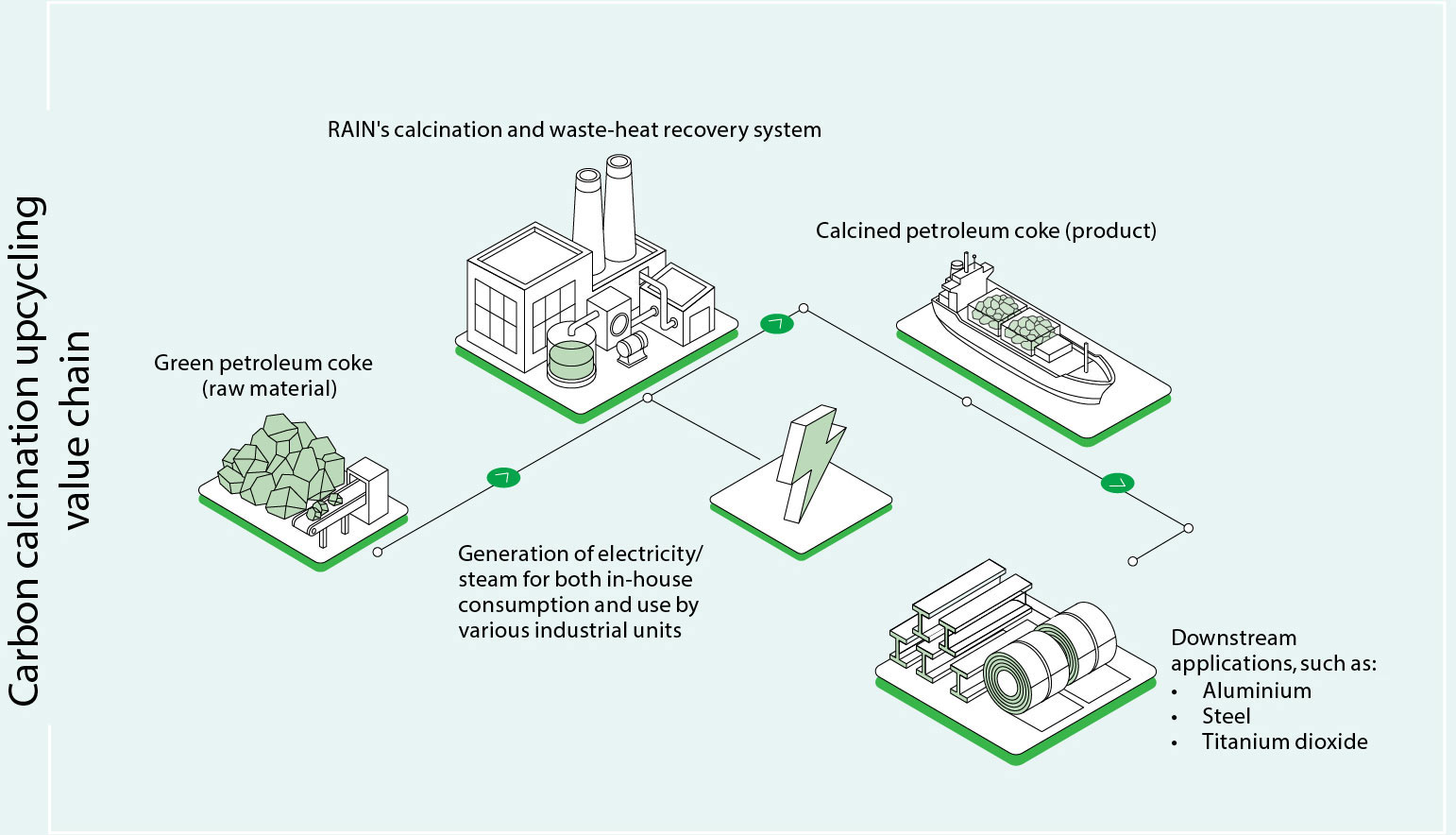
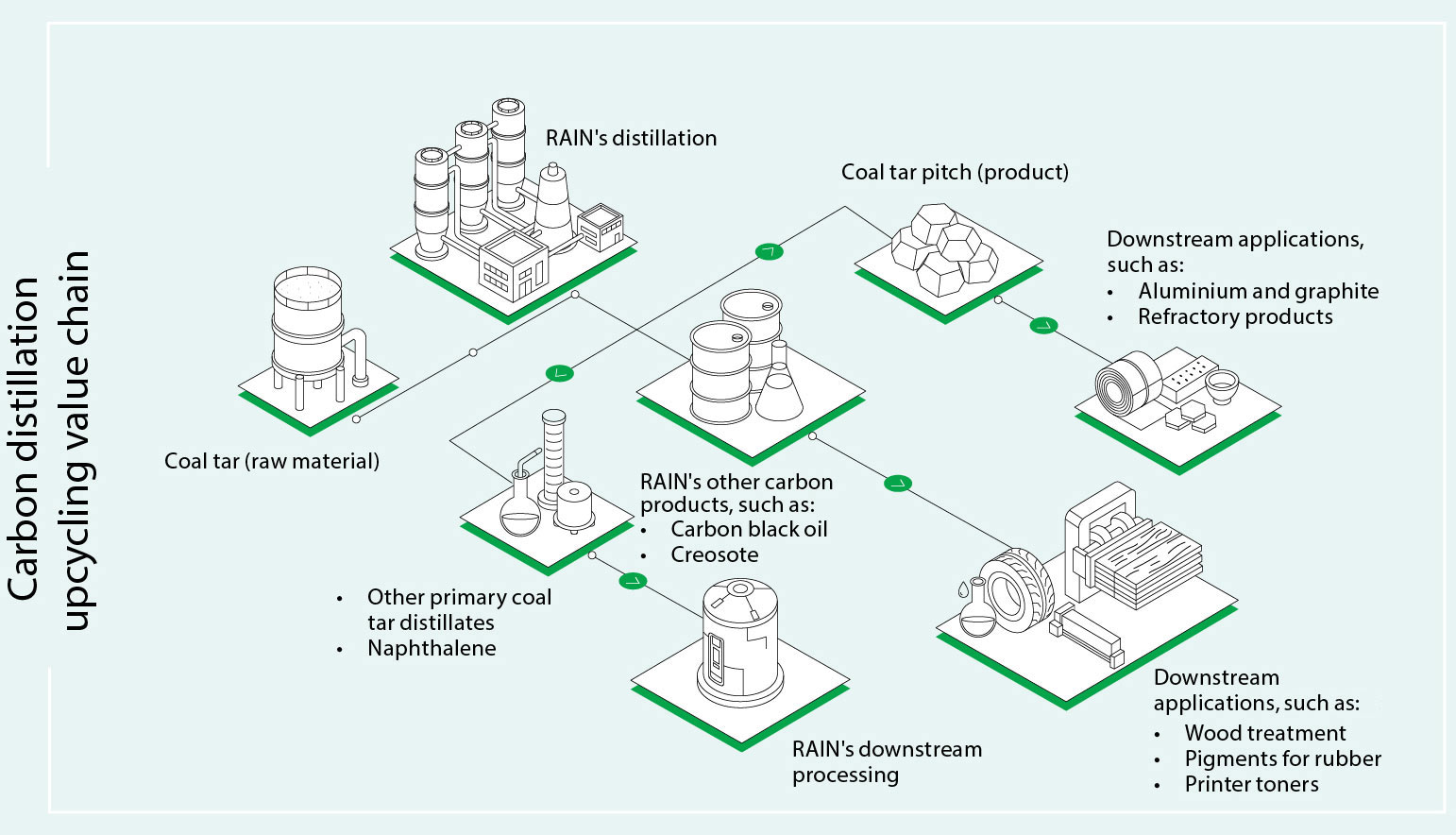
Green Petroleum Coke (GPC) is a byproduct of crude oil refining. | Coal tar is a byproduct of metallurgical coke used in the iron and steel industries. | |
| Manufacturin | CPC is created through a hightemperature calcining process using rotary-kiln and verticalshaft technologies, effectively eliminating moisture and volatile matter from GPC. | CTP is obtained by distilling coal tar, which separates its components based on varying boiling points. | Other carbon products are generated through the distillation of coal tar, a process that separates its components based on their distinct boiling points. |
| End-industry applications |
CPC is essential for producing anodes used in primary aluminium production, as well as in the steel and titanium dioxide industries. | CTP is a vital raw material for anodes utilised in the aluminium industry, as well as in the graphite and refractory sectors. | These products are utilised in various industries, including wood treatment, carbon black production, and construction, among others. |
| Production locations |
India and the United States | Belgium, Canada, Germany, Poland and Russia | Belgium, Canada, Germany and Russia |
The Carbon segment maintained stable operations in 2025, supporting aluminium smelting, steelmaking and other hightemperature industries. Sales volume reached 2.59 million tonnes, driven by production ramp-ups and steady customer demand. The Atchutapuram calcining plant achieved full operational capacity during the year, increasing production capability to 370,000 TPA and strengthening supply reliability. The segment also advanced the development of a new coal tar pitch production facility in India, with an initial capacity of 50,000 TPA, eventually expandable to 200,000 TPA.
Capacity utilisation
The segment demonstrated resilience amid market volatility, with EBITDA growth in the initial part of the year supported by higher CPC volumes following the easing of import restrictions and strong calcination margins. This momentum was partly offset by margin compression in the distillation business due to softer CTP prices and elevated raw material costs, while geopolitical disruptions affected shipment timing and volume stability during the year. Operational optimisation initiatives supported overall performance, and improved distillation volumes in the latter part of the year helped balance lower calcination volumes. The business continues to navigate evolving tariff structures and tightening raw material availability amid rising demand from the Li-ion battery industry.
The global green and calcined petroleum coke market is projected to grow by US$12.94 billion at a CAGR of 7.1% between 2024 and 2029, driven primarily by rising aluminium and steel production, the largest end-use segments, alongside advancements in refining processes that improve supply efficiency. Market conditions, however, remain influenced by crude oil price volatility impacting freight costs and profitability, while constrained availability of GPC, amid rising demand from high-value applications such as battery anodes, continues to tighten supply.
We strengthened our calcination capabilities through capacity enhancement initiatives, including the commissioning and ramp-up of our shaft calciner, which achieved full design capacity in 2025, improving our ability to serve global aluminium, titanium dioxide and steel customers. Our integrated global operations support feedstock blending and product consistency across facilities, enabling cost optimisation and operational efficiency amid input cost volatility.
The global CTP market is projected to grow at a CAGR of 4.5% between 2025 and 2030, supported by expanding aluminium smelter capacity across key markets such as southeast Asia and India, increasing adoption of graphite-electrode Electric Arc Furnace (EAF) steelmaking driven by decarbonisation mandates, and sustained refractory demand across the AsiaPacific region. Market growth, however, remains constrained by shrinking coal tar availability due to the declining coke-oven fleet in North America and Europe, while feedstock scarcity and elevated spot prices continue to compress profitability across downstream electrode and refractory value chains.
In 2025, RAIN took steps toward expanding CTP production into the heart of the aluminium smelting growth region, obtaining the required approvals, including environmental clearances, for its future production site in India. We are strengthening procurement flexibility and optimising logistics to address global tar supply constraints, while maintaining a disciplined focus on operational efficiency and pricing to manage higher raw material costs, protect margins and sustain stable volumes across key markets.
During 2025, we strengthened our globally integrated carbon business model through diversified feedstock sourcing and optimisation of our international manufacturing and logistics network, enhancing procurement flexibility and cost control amid volatile raw material markets. We continued to advance technologyled product development, with focused initiatives in biocarbon and next-generation anode materials aligned with evolving sustainability requirements. Investments across carbon facilities remained directed toward pollution control, energy efficiency and process optimisation, supporting operational efficiency while reducing environmental impact.
Strategic focus areas for 2026
Our priorities for 2026 centre on margin stabilisation through sustained cost optimisation and expanded sourcing of diverse GPC grades supported by improved logistics solutions. We are advancing portfolio innovation through the integration of biocarbon materials and preparing to eventually commence CTP production in India after having received the regulatory approvals and environmental clearances. RAIN aims to subsequently expand into the production of higher-value carbon products in a following phase. This phased approach is expected to support disciplined capital deployment, operational scalability and gradual margin expansion.